This last week started badly with Hailey having another case of meningitis, but ended incredibly, with Hailey bouncing back and me finding absolute treasures at Shelley Duvall’s house. (Long story. It’s on my blog.) And it was sprinkled with little bits of insanity as internet rapture jokes (did you know it’s supposed to rapture?) made me laugh while also lightly triggering my past religious trauma. Ah, the complicated pleasures of being alive!
I’m trying to focus less on the loud bullshit in the world that I can’t control, and focus more on the quiet good in the world that inspires me to keep going and to do small things to make the world better. It is really hard though because I tend to hyper-focus on “SOMEONE ON THE INTERNET IS WRONG AND/OR MEAN” rather than “Someone on the internet is kind and calming and has a good plan to help others that I can support.” How long will this well-intentioned plan last? Probably 4-6 hours, with my record. But it’s worth a shot.
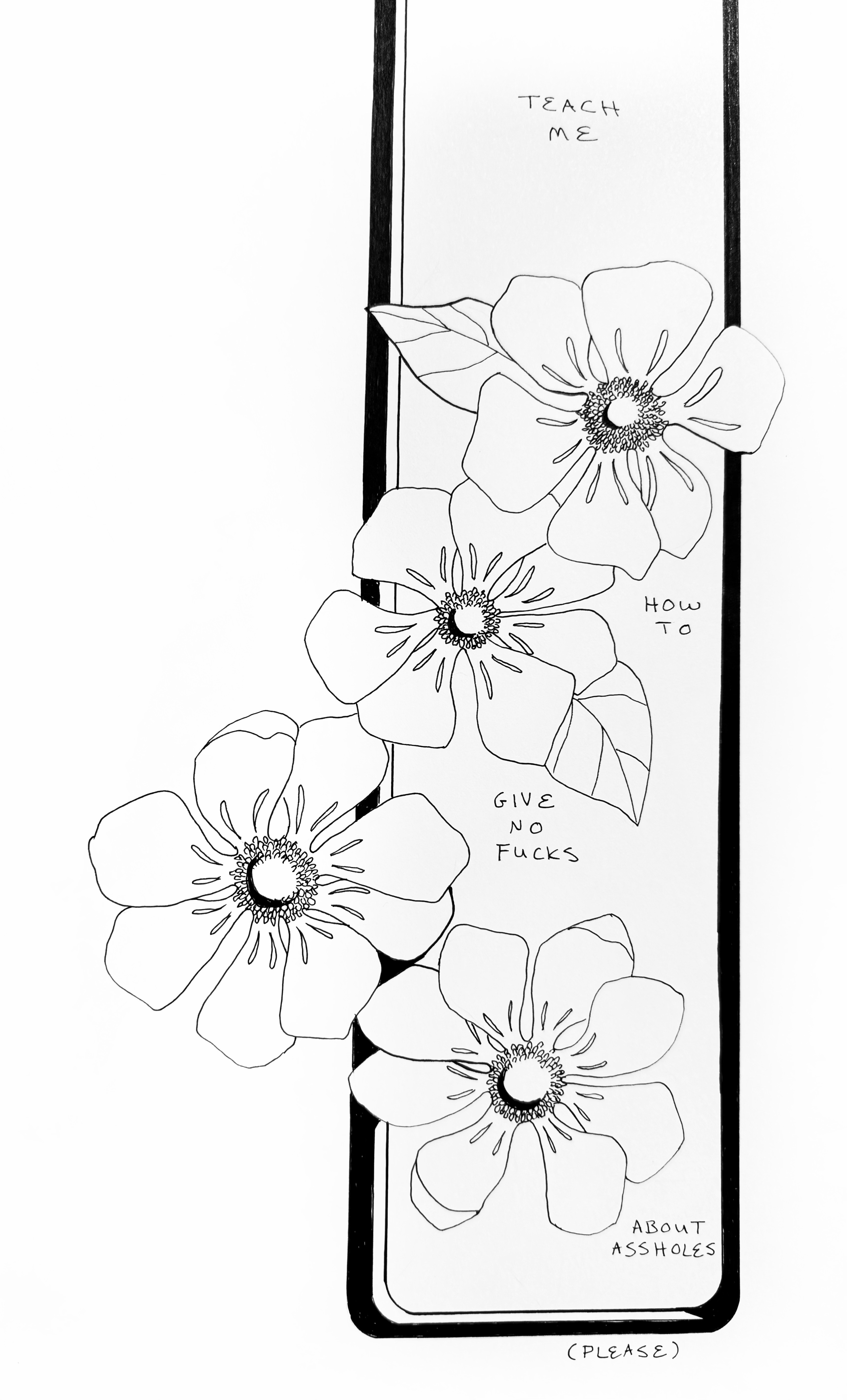
And that’s what this week’s doodle is about.
“Teach me how to give no fucks about assholes. (Please.)”
I super crazy love you. Thank you for being a bright spot to focus on in a sometimes dark little world. You make a difference.
I have no idea if this is going to make me One Of Those People Who Leaves Those Kinds Of Comments, but on the subject of teaching: I'm going to leave you a real-life story, because I found it truly amazing when I first learned of it a few weeks ago.
It's this:
Neuroscientist Dr Susan Barry is asked a very strange question:
“Do you think you can imagine what it's like to see the world with two eyes?”
Her response, in her own words:
“Yes, of course, I can imagine that. I'm a college professor, I teach about it in class. So, yes, I think I know exactly what it is I'm missing.”
Susan was born cross-eyed, which rendered her stereoblind, unable to see with binocular vision. She eventually had it surgically corrected, but only after the age of two - beyond the point where the brain cells involved in binocular vision have learned to work together. For her, despite her eyes now being aligned, her vision remained depthless, nothing between the near and the far. Her view of the world is as flat as it appears to a binocular-visioned person with one eye scrunched shut.
Three months after giving this reply, she sends her questioner back a letter, which covers 9 single-spaced pages and begins with these words:
“Dear Dr. [Oliver] Sacks, you asked me this question, I gave you this answer, and I was completely wrong.”
What’s happened is this. One morning, after a session with the developmental optometrist she’s been working with, she’s sitting in her car ready to depart - and in front of her, the steering wheel starts floating away from the dash.
“It was in its own three-dimensional space. I had never had that type of perception before and I didn't believe it, cause I knew that this was impossible.”
Her whole life, she’d been told her vision could never correct itself. That was the accepted wisdom, and as a neuroscientist, that’s what she taught her students. Once your vision was set one way, that was just that.
“I could not develop stereo vision, and so I drove home and tried to forget about it.”
But the next day, when she gets into her car again, she finds her rear-view mirror is doing the same thing. It’s hovering in mid-air - not part of the two dimensional view that makes up everything she had ever seen, but somehow above it, and for the first time in her life she doesn’t have to intuit the space behind it, because she can actually see it.
It keeps happening - and one day, she steps out of her college building to find herself not just watching the snow fall, but finding herself inside it:
“…it was one of those late winter snows with big, thick snowflakes coming down very lazily, and I could see each snowflake in its own three-dimensional space, and there was space between each snowflake, and it was like this beautiful, three-dimensional dance, and I had this real sense of being within the snowfall.
Prior to that, before my therapy, if I looked at a snowfall, all the snowflakes fell in one plane, slightly in front of me, and I was not really part of the snowfall, I was looking into the snowfall. And now, I had the sense of being within the snowfall - in the midst of the snowfall - all these beautiful flakes just falling all around me, and I just was completely filled with a sense of joy.
I'd never seen anything like that. I completely forgot about lunch. I just stood there in the middle of the campus watching the snow.”
At the age of 48, Susan Barry had gained a new sense - and in doing so she moved from her world into an entirely new one that was far beyond what even her professionally trained mind could imagine, what Maria Popova calls “the abyss between felt experience and our mental models of it" (https://www.themarginalian.org/2024/02/07/dear-oliver/)...
And it’s utterly overwhelming in its everyday wonder.
So maybe other things can be too, for all of us, if we can just find them.
I just want you to know that you've kept me going for the last 18 years that I've been reading your work. I'm glad you exist. I hope you can find the peace to keep going.


All the love to you. You're still the best.
I have no idea if this is going to make me One Of Those People Who Leaves Those Kinds Of Comments, but on the subject of teaching: I'm going to leave you a real-life story, because I found it truly amazing when I first learned of it a few weeks ago.
It's this:
Neuroscientist Dr Susan Barry is asked a very strange question:
“Do you think you can imagine what it's like to see the world with two eyes?”
Her response, in her own words:
“Yes, of course, I can imagine that. I'm a college professor, I teach about it in class. So, yes, I think I know exactly what it is I'm missing.”
Susan was born cross-eyed, which rendered her stereoblind, unable to see with binocular vision. She eventually had it surgically corrected, but only after the age of two - beyond the point where the brain cells involved in binocular vision have learned to work together. For her, despite her eyes now being aligned, her vision remained depthless, nothing between the near and the far. Her view of the world is as flat as it appears to a binocular-visioned person with one eye scrunched shut.
Three months after giving this reply, she sends her questioner back a letter, which covers 9 single-spaced pages and begins with these words:
“Dear Dr. [Oliver] Sacks, you asked me this question, I gave you this answer, and I was completely wrong.”
What’s happened is this. One morning, after a session with the developmental optometrist she’s been working with, she’s sitting in her car ready to depart - and in front of her, the steering wheel starts floating away from the dash.
“It was in its own three-dimensional space. I had never had that type of perception before and I didn't believe it, cause I knew that this was impossible.”
Her whole life, she’d been told her vision could never correct itself. That was the accepted wisdom, and as a neuroscientist, that’s what she taught her students. Once your vision was set one way, that was just that.
“I could not develop stereo vision, and so I drove home and tried to forget about it.”
But the next day, when she gets into her car again, she finds her rear-view mirror is doing the same thing. It’s hovering in mid-air - not part of the two dimensional view that makes up everything she had ever seen, but somehow above it, and for the first time in her life she doesn’t have to intuit the space behind it, because she can actually see it.
It keeps happening - and one day, she steps out of her college building to find herself not just watching the snow fall, but finding herself inside it:
“…it was one of those late winter snows with big, thick snowflakes coming down very lazily, and I could see each snowflake in its own three-dimensional space, and there was space between each snowflake, and it was like this beautiful, three-dimensional dance, and I had this real sense of being within the snowfall.
Prior to that, before my therapy, if I looked at a snowfall, all the snowflakes fell in one plane, slightly in front of me, and I was not really part of the snowfall, I was looking into the snowfall. And now, I had the sense of being within the snowfall - in the midst of the snowfall - all these beautiful flakes just falling all around me, and I just was completely filled with a sense of joy.
I'd never seen anything like that. I completely forgot about lunch. I just stood there in the middle of the campus watching the snow.”
At the age of 48, Susan Barry had gained a new sense - and in doing so she moved from her world into an entirely new one that was far beyond what even her professionally trained mind could imagine, what Maria Popova calls “the abyss between felt experience and our mental models of it" (https://www.themarginalian.org/2024/02/07/dear-oliver/)...
And it’s utterly overwhelming in its everyday wonder.
So maybe other things can be too, for all of us, if we can just find them.
The end(/beginning).
I just want you to know that you've kept me going for the last 18 years that I've been reading your work. I'm glad you exist. I hope you can find the peace to keep going.